Day 7: Skip the Nightcap and Review Your First Week
Day 7 of Better Sleep: why alcohol fragments sleep even though it makes you drowsy, what to drink instead, and a simple Week 1 review of what to keep, what to fix, and what Week 2 adds.
Medically reviewed by Lena Hartmann, PhDFact checked by Amara Okafor, MDWritten by Marcus Bell, PharmDUpdated on
Key takeaways
- Alcohol is a sedative, not a sleep aid. It helps you fall asleep, then fragments the second half of the night and suppresses REM sleep from about 2 drinks.
- One study of 4,098 employees found overnight recovery fell by 9.3 points after a low dose, 24 after a moderate dose, and 39.2 after a high dose.
- Higher alcohol use is linked to a 25 percent higher risk of sleep apnoea, and alcohol relaxes throat muscles so snoring gets louder.
- Your liver clears roughly one standard drink per hour. Two drinks need about 2 hours and three need about 3, so the 3 to 4 hour rule is a minimum, not a guarantee.
- A 7 day alcohol free evening test is the cleanest way to know your own effect. Compare falling asleep time, night wakings, and morning freshness.
Day 7: Skip the Nightcap and Review Your First Week
Alcohol is the most convincing fake sleep aid there is. It makes you feel drowsy, and then it quietly breaks your sleep apart.
Today is the last habit of Week 1, and a checkpoint. You have built six habits in six days. Let's look at what alcohol does to your sleep, and how to review your first week.
Quick answer: Skip alcohol in the evening for 7 days and compare your mornings. Alcohol can help you fall asleep faster, but it fragments the second half of the night and suppresses REM sleep. The effect starts at about 2 drinks and grows with dose. It is also a common cause of waking at 3 a.m.. If you do drink, stop at least 3 to 4 hours before bed.
Why Alcohol Breaks Your Sleep
Alcohol acts like a sedative. A drink can make you feel relaxed and sleepy, and you may fall asleep faster than usual. That is why the nightcap feels like it works.
Later in the night, as your body clears the alcohol, sleep turns lighter and more broken. You wake more often, get less deep sleep and less REM sleep, and you may wake at 3 a.m. and feel unrefreshed. Alcohol also relaxes throat muscles, so snoring gets louder and sleep apnoea can get worse. Even one or two drinks can do this, so test it for a week, as you did with caffeine.
What the numbers say
A 2013 meta-analysis by Ebrahim and colleagues found the same pattern at every dose. Alcohol helps you fall asleep and deepens the first half of the night, then it disrupts the second half. The REM effect depends on dose:
Dose | What it is, roughly | Effect on sleep |
|---|---|---|
Low, under 0.4 g/kg | 1 drink | More deep sleep first half, little REM loss |
Moderate, 0.4 to 0.8 g/kg | About 2 to 3 drinks | REM reduced all night |
High, over 0.8 g/kg | About 4 to 5 or more drinks | Strong REM loss, most wakefulness second half |
One standard drink is roughly 14 g of pure alcohol, a 12 oz beer, 5 oz of wine, or 1.5 oz of spirits. Counts are approximate.
Your liver clears roughly one standard drink per hour:
If you have | It clears in about | So for a 10 p.m. bedtime, finish by |
|---|---|---|
1 drink | 1 hour | 9 p.m. |
2 drinks | 2 hours | 8 p.m. |
3 drinks | 3 hours | 7 p.m. |
So the 3 to 4 hour rule is a minimum, not a guarantee. A 2018 study of 4,098 employees found overnight recovery fell by 9.3 points after a low dose, 24 after a moderate dose, and 39.2 after a high dose. A review of 31 studies linked higher alcohol use to a 25 percent higher risk of sleep apnoea. One caveat: a 2025 pooling could not pin down the effect on total sleep time. The REM finding, starting at about two drinks, is the one that survived.
“What alcohol gives on those first two nights, it takes away on subsequent nights. You become tolerant to it, and then your sleep is even worse than initially.”
Your Day 7 Plan
1. Make tonight alcohol free, and keep the evening that way for 7 days. No drink with dinner, no nightcap. This is a test, not a lifetime rule. One night proves little. Seven nights give you a pattern.
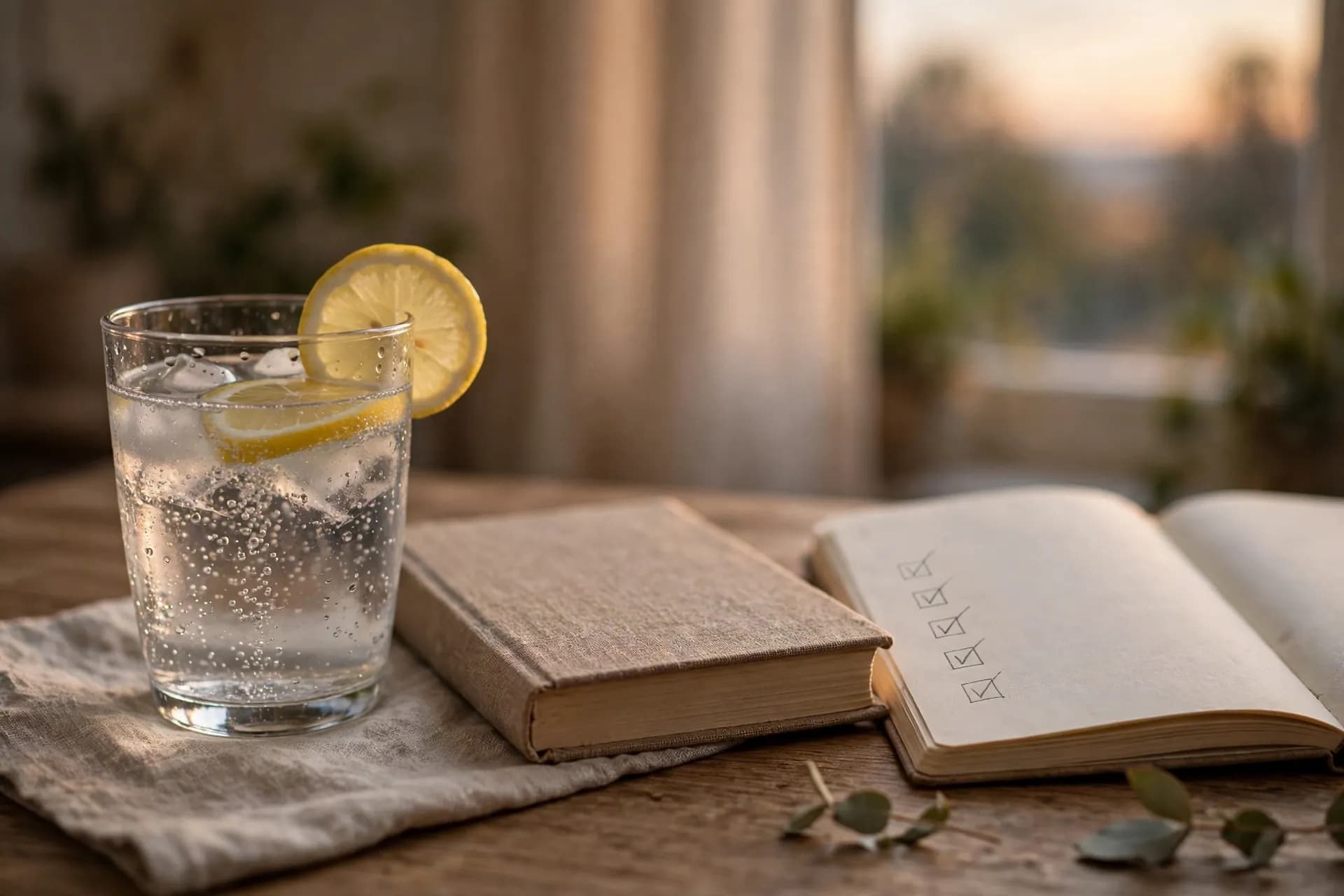
2. Replace the ritual, not just the drink. Like the afternoon coffee on Day 4, the evening drink is usually a ritual, a glass in hand, a signal that the day is over. Replace it with sparkling water with lemon or herbal tea.
3. If you do drink, drink earlier and less. Have it with food, earlier in the evening, and stop at least 3 to 4 hours before bed.
4. Do your Week 1 review tonight, it takes 10 minutes. Mark each habit working, slipping, or not tried. Use the Sleep Calculator to check your bedtime still leaves 7 to 9 hours.
Habit | Day | Working? | One fix for next week |
|---|---|---|---|
Same wake time, 7 days a week | |||
30-minute wind-down, same order | |||
Cool, dark, quiet bedroom | |||
Caffeine cut-off 8 to 9 hours before bedtime | |||
30 minutes of daytime movement | |||
Short nap before 3 p.m., or none | |||
No alcohol in the evening | Day 7 (this page) |
Keep working habits as they are. For the one that slipped most, pick one fix. If wake time slipped on weekends, set one weekend alarm.
5. Do not add new habits yet. Week 2 will add new ones. This week, keep Week 1 steady. That is why this guide is 21 days, not 7.
Common Mistakes
"One drink helps me sleep, so it must be fine." Falling asleep faster is only the first hour. Judge a drink by the whole night.
Quitting for one night and declaring it made no difference. One night is not a test. Give it 7 evenings.
Replacing alcohol with a sleeping pill or a supplement. That swaps one sleep disruptor for another. Talk to your clinician instead.
Trying to fix everything in Week 1. Fix the bedroom first. Do not also overhaul your diet, start running, and quit caffeine the same day.
Calling the week a failure because one night was bad. One bad night is normal. Judge the week, not the worst night. If 5 of 7 nights were better, Week 1 worked.
What To Do Next
Tonight is alcohol free, and your Week 1 review is done. That completes Week 1, 7 of 21 days.
See the full program: 3 Weeks to Better Sleep and Sleep hub
Medical disclaimer: This content is for information only, not medical advice, diagnosis, or treatment. If you drink heavily or daily, do not stop suddenly without medical advice. Alcohol withdrawal can be dangerous and needs supervision. If you have persistent insomnia, sleep apnoea, or you use alcohol to cope with stress or anxiety, talk to a qualified healthcare professional.
The takeaway
Red wine, beer, and spirits all break up your sleep in the same way. It is the alcohol itself that does it, not the drink it comes in. A "healthy" red wine still fragments the second half of your night, just like any other drink with the same amount of alcohol.
Frequently asked questions
How long before bed should I stop drinking?
At least 3 to 4 hours is a practical minimum. One drink clears in about an hour, three drinks in about three.
Does red wine affect sleep differently from beer or spirits?
Not in any way that matters. The active ingredient is the alcohol itself.
What if I drink every evening and sleep fine?
You may be less affected, or you may have adapted to lighter sleep. The 7 day test is still worth doing.
Can I use alcohol to help with anxiety at night?
It can feel calming in the moment, but it makes anxiety worse the next day. If anxiety keeps you awake, Box Breathing is a calmer tool, and talking to your clinician is the better step.
When should I talk to a doctor about sleep?
If you have trouble sleeping 3 or more nights a week for 3 months or more, snore loudly with gasping, fall asleep suddenly during the day, or have low mood or anxiety with poor sleep, talk to your clinician.
How we reviewed this article
Beargoal has strict sourcing guidelines and relies on peer-reviewed studies, academic research institutions and medical associations. We avoid tertiary references. Learn more in our editorial process.
- Ebrahim et al. (2013). Alcohol and Sleep I: Effects on Normal Sleep. Alcohol and sleep. https://pubmed.ncbi.nlm.nih.gov/23347102/
- Gardiner et al. (2025). The Effect of Alcohol on Subsequent Sleep in Healthy Adults: A Systematic Review and Meta-Analysis. https://pubmed.ncbi.nlm.nih.gov/39631226/
No revisions recorded yet.
Medically reviewed by Lena Hartmann, PhDFact checked by Amara Okafor, MDWritten by Marcus Bell, PharmDUpdated on
This content is for informational purposes only and is not medical advice, diagnosis or treatment. Read our full disclaimer.