Day 5: Move More During the Day
Day 5 of Better Sleep: how daytime movement deepens sleep, how much you need, the best time to exercise, and a simple walking plan that fits a busy day.
Medically reviewed by Sam WhitfieldFact checked by Lena Hartmann, PhDWritten by Marcus Bell, PharmDUpdated on
Key takeaways
- A 2015 review of 66 studies found exercise gives small to moderate sleep gains. One workout added roughly 13 minutes of sleep, and regular exercise adds more.
- Aim for 150 minutes a week of moderate activity. That is 30 minutes, 5 days a week, and three 10 minute walks count the same as one 30 minute walk.
- Morning or lunch is ideal because daylight does double duty: movement plus the body clock signal from Day 1.
- Evening exercise is less risky than the old rule suggests. Kredlow found no clear difference by time of day, and a later review found evening exercise slightly deepened sleep.
- Gentle evening movement is different from a workout. Slow stretching belongs in your wind-down, not instead of daytime movement.
Day 5: Move More During the Day
Picture a normal busy day. You eat lunch at your desk and take the lift instead of the stairs. By 4 p.m. your shoulders feel stiff, and your eyes feel heavy. The best sleep aid might be the walk you take at lunch. Not a gym session. Not a run. Just a walk, outside, in daylight.
Sleep is not only decided at night. How much you move, and how much daylight you get, shapes how deeply you sleep. People who move regularly tend to fall asleep faster and sleep more deeply. You need less than you think.
Quick answer: Aim for about 30 minutes of movement today. A brisk walk is enough. Try to do it in daylight. Regular movement, not one hard workout, improves sleep. A 2015 review of 66 studies found small to moderate gains.
Why Movement Helps You Sleep
Think of sleep pressure as a tank that fills up during the day. One part comes from adenosine, the chemical from Day 4. It builds all day.
The other part is body temperature. Exercise warms you up, and the cool-down a few hours later tells your brain it is time to feel sleepy.
Movement also lowers stress and worry, two of the most common reasons people lie awake. It can lift your mood. Let us be honest. Exercise is not a sleeping pill. The effects are real, but they are modest. The best summary is a 2015 meta-analysis by Kredlow and colleagues in the Journal of Behavioral Medicine, which pooled 66 studies.
“We have solid evidence that exercise does, in fact, help you fall asleep more quickly and improves sleep quality.”
What exercise changed | One session | Regular exercise over weeks |
|---|---|---|
Total sleep time | Small benefit | Small benefit |
Time to fall asleep | Small benefit | Small to medium benefit |
Sleep efficiency, the share of time in bed spent asleep | Small benefit | Small benefit |
Deep, slow wave sleep | Small benefit | Not reported |
Waking up after falling asleep | Moderate benefit | Not reported |
Overall sleep quality, how rested people felt | Not reported | Moderate benefit |
Read that as minutes, not hours. One walk helps a little that night. The bigger gain comes after weeks of regular movement.
How Much, and When?
The general adult target, from the CDC and WHO, is about 150 minutes a week of moderate activity. That means brisk walking, cycling, or swimming, plus muscle strengthening on 2 days a week. That is 30 minutes, 5 days a week.
Morning or lunchtime is ideal. You get daylight too, which strengthens the body clock signal from Day 1,
Afternoon is fine too. A walk after lunch helps with that heavy post-lunch dip.
Evening exercise is less risky than the old rule suggests, but test it yourself. You have probably heard that you should finish vigorous exercise at least 3 hours before bed. For some people that is good advice. But Kredlow's analysis found no detectable difference in falling asleep time, total sleep, or efficiency whether exercise was done more than 8 hours, 3 to 8 hours, or less than 3 hours before bed. A later meta-analysis of 23 evening exercise studies found the same pattern, with deep sleep up about 1.3 percent of the night and light stage 1 sleep down about 0.9 percent. Some people do feel wired after a late hard session. If evening is your only free time, try it for a week. If it takes you longer to fall asleep, move the hard session earlier and keep the evening gentle.
Gentle evening movement is different. Slow stretching, easy yoga, or a short stroll after dinner are calming, not stimulating. Our 5-minute desk stretch routine is a good example. It belongs in your evening wind-down, not as a replacement for daytime movement.
Your Day 5 Plan: Do This Today
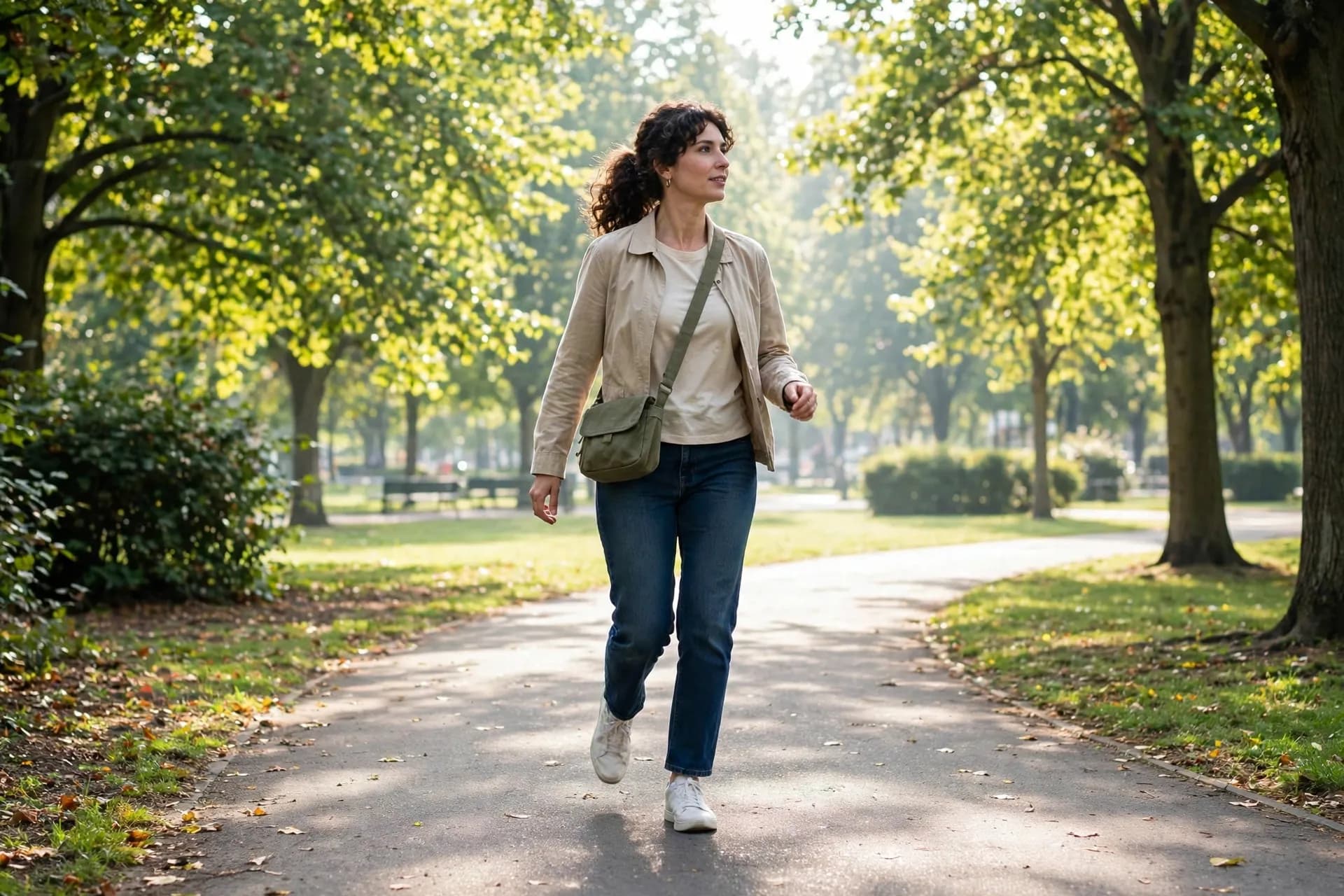
1. Take one 30-minute brisk walk. Brisk means you can talk but not sing. You should feel slightly warm and breathe a little faster. Split it if you need to. Three 10-minute walks count just as well.
2. Do it in daylight if you can. A morning or lunchtime walk outside gives you the light signal as well as the movement. Even 10 minutes outside at lunch helps. Read more in Health Benefits of Walking Every Day.
3. Add one small strength habit this week, not today. Pick two days this week for 10 minutes of bodyweight movement. Squats, wall push-ups, or the desk stretches from our video routine all count.
4. Keep the rest of the program going. Keep the same wake time (Day 1), the same wind-down (Day 2), a cool dark bedroom (Day 3), and the noon caffeine cut-off (Day 4). Use the Sleep Calculator if your new wake time means your bedtime needs to shift to keep 7 to 9 hours.
5. Note how you feel tomorrow, not just tonight. The sleep benefit is clearest after a week of regular movement. Write down one line tonight, for example, "walked 30 min at lunch", and one line tomorrow morning about how long it took to fall asleep.
Common Mistakes
Doing one exhausting workout and then stopping. A single hard session leaves you sore, and then you skip the next three days. Sleep improves with regular moderate movement, not with occasional punishment.
Exercising hard right before bed, then blaming the routine. For most people,
a hard session in the evening is fine. But if your falling asleep time gets longer on workout nights, that is your answer.
Counting steps but never getting daylight. Steps indoors still count as movement, but you lose the light benefit.
Expecting exercise to fix a 2 a.m. wake. Movement helps you fall asleep and sleep more deeply, but waking at 3 a.m. has many causes. Stress, alcohol, needing the toilet, and sleep apnoea are all on that list, and they are covered in Why Do I Keep Waking Up at 3 a.m.?.
Pushing through pain. Some muscle soreness after starting is normal. Joint pain, chest pain, dizziness, or breathlessness that feels wrong is not. Stop and talk to your clinician first.
See the full program: 3 Weeks to Better Sleep · Sleep hub
Medical disclaimer: This content is for informational purposes only and is not medical advice, diagnosis, or treatment. If you have a heart condition, breathing problems, joint problems, or have been inactive for a long time, talk to a qualified healthcare professional before starting a new exercise routine. Stop exercising and seek care if you develop chest pain, severe shortness of breath, dizziness, or fainting.
The takeaway
Walk 30 minutes today, in daylight if you can. Tomorrow, in Day 6, we fix the nap. You will learn how a short nap can help, and how a long or late one steals your night's sleep.
How we reviewed this article
Beargoal has strict sourcing guidelines and relies on peer-reviewed studies, academic research institutions and medical associations. We avoid tertiary references. Learn more in our editorial process.
- Kredlow, M. A. et al. (2015). The effects of physical activity on sleep: a meta-analytic review. Journal of Behavioral Medicine.
No revisions recorded yet.
Medically reviewed by Sam WhitfieldFact checked by Lena Hartmann, PhDWritten by Marcus Bell, PharmDUpdated on
This content is for informational purposes only and is not medical advice, diagnosis or treatment. Read our full disclaimer.