Normal Blood Sugar Levels by Age: Fasting, After Eating and A1C Chart
Normal blood sugar for adults: fasting blood sugar under 100 mg/dL, A1C under 5.7%. ADA and CDC charts: diabetes targets and when to see a doctor.
Medically reviewed by Daniel Reyes, MS, RDFact checked by Amara Okafor, MDWritten by Lena Hartmann, PhD
Key takeaways
- Normal (adults, no diabetes): fasting under 100 mg/dL, A1C under 5.7%, and under 140 mg/dL two hours into a glucose tolerance test.
- Prediabetes: fasting 100 to 125 mg/dL, A1C 5.7% to 6.4%, 2-hour test 140 to 199 mg/dL.
- Diabetes: fasting 126 mg/dL or higher, A1C 6.5% or higher, 2-hour or random glucose 200 mg/dL or higher. The ADA says a result usually needs repeating on a second day.
- Age does not move the adult diagnosis cutoffs. It can change the treatment target. For most adults with diabetes, the ADA targets are A1C under 7%, 80 to 130 mg/dL before meals, and under 180 mg/dL one to two hours after a meal starts. Older adults or people at higher risk of lows may get a looser goal, such as under 8%.
- One reading is not a diagnosis. Fasting, illness, stress, and the type of meter or lab all affect the number. Under 70 mg/dL is low and needs treatment.
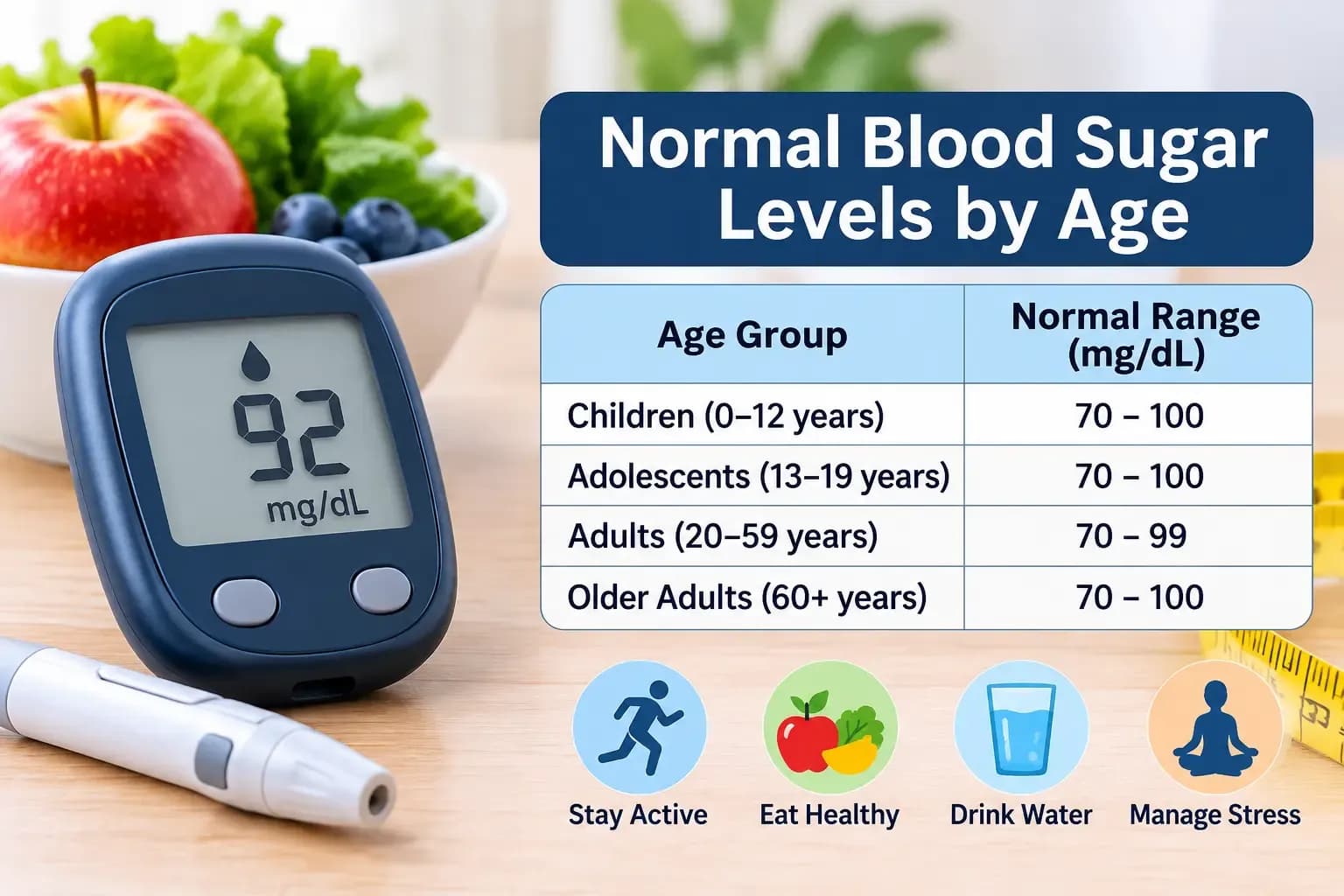
For most adults without diabetes, a normal fasting blood sugar is 99 mg/dL (5.5 mmol/L) or lower, and a normal A1C is below 5.7%. These cutoffs are the same for every adult, whether you are 25 or 75. What changes with age and health is the target for people who already have diabetes. This guide gives the diagnostic ranges, the treatment targets, what low and high readings mean, and what to do next. Every number comes from the American Diabetes Association (ADA) or the CDC, and we link to the page it came from.
Normal blood sugar chart for adults
These are the ranges doctors use to diagnose prediabetes and diabetes. They apply to adults of any age who are not pregnant.
Test | Normal | Prediabetes | Diabetes |
|---|---|---|---|
A1C | Below 5.7% | 5.7% to 6.4% | 6.5% or higher |
Fasting blood sugar | 99 mg/dL or lower | 100 to 125 mg/dL | 126 mg/dL or higher |
Glucose tolerance test (2-hour reading) | Below 140 mg/dL | 140 to 199 mg/dL | 200 mg/dL or higher |
Random blood sugar | n/a | n/a | 200 mg/dL or higher |
Source: ADA diabetes diagnosis and CDC diabetes testing.
The ADA notes that each test usually needs to be repeated the next day to diagnose diabetes. You may not need a second test if your blood glucose is very high or if classic high-sugar symptoms appear with one positive test. If your number came from a health fair or pharmacy, the CDC advises following up with your doctor, who may retest.
Blood sugar targets if you already have diabetes
A target is not the same as a normal range. It is the level a care team aims for in a person who has diabetes. These ADA targets are for most non-pregnant adults.
Measure | Typical adult target | When a doctor may set a different goal |
|---|---|---|
A1C | Below 7% | Less strict goals, such as below 8%, can fit older age, low-sugar episodes or unawareness of them, reduced life expectancy, vascular complications, several other conditions, patient preference or limited support |
Before meals | 80 to 130 mg/dL | Set by your care team |
1 to 2 hours after a meal starts | Below 180 mg/dL | Set by your care team |
Source: ADA glycemic targets sheet. Ask your doctor for your own numbers. If you are newly diagnosed, our type 2 diabetes guide explains the whole picture, and the early signs article lists symptoms to watch for.
Does normal blood sugar change with age?
For diagnosis in adults, no. A 30-year-old and an 80-year-old are both read against the same fasting, A1C and glucose tolerance cutoffs. The age effect shows up in treatment goals and in how much risk a care team will accept. A tight target that suits a healthy 45-year-old can be risky for an 82-year-old who is prone to low blood sugar.
Age group | Diagnosis cutoffs | What to know |
|---|---|---|
Children and teens | Do not rely on an adult chart | Targets are set by the child's diabetes team and are individual. Talk to your pediatrician or endocrinologist. |
Adults 18 to 64 | Same as the chart above | Prediabetes and type 2 diabetes often cause no symptoms. The CDC says people with risk factors should ask a doctor whether to be tested. |
Adults 65 and older | Same as the chart above | If you have diabetes, a doctor may choose a looser A1C goal (such as below 8%), especially with low-sugar episodes or other health conditions. |
Pregnancy | Different | Gestational diabetes testing usually happens between 24 and 28 weeks, earlier for higher-risk people (CDC). Your obstetric team sets the targets. |
Sources: CDC diabetes testing and ADA glycemic targets.
How to measure it: fasting, home meter, lab or CGM
The same person can see different numbers depending on how and when they test. Know which kind of test you are looking at before you compare it with a chart.
- Fasting test: no food or caloric drinks for at least 8 hours, usually first thing in the morning. Water is fine. Our fasting blood sugar guide covers preparation.
- Lab test (plasma glucose): the method used for diagnosis.
- Home fingerstick meter: handy for tracking, but it can differ from a lab result, so use it for trends and let a lab confirm a diagnosis.
- Continuous glucose monitor (CGM): measures glucose in the fluid under the skin and reads slightly behind blood. Do not compare a CGM line directly with a lab value.
- A1C: reflects your average over roughly the past three months and does not need fasting.
If you want to understand which test fits which question, read diabetes tests explained.
What is a normal blood sugar after eating?
This is the most confused number on the internet, because three different things get called "after eating."
- Glucose tolerance test: a lab drink with a set amount of glucose, then a blood draw at 2 hours. Below 140 mg/dL is normal, 140 to 199 mg/dL is prediabetes and 200 mg/dL or higher is diabetes.
- A normal meal in a person without diabetes: there is no official diagnostic range, because meals differ. Many health sources treat a reading under 140 mg/dL at 2 hours as typical, which matches the test above.
- A person with diabetes: the ADA target is below 180 mg/dL, measured 1 to 2 hours after the start of the meal.
The first two are about telling healthy from unhealthy. The third is a treatment goal. Mixing them up is how people end up thinking 170 mg/dL is "normal." For a deeper look at timing, see blood sugar after eating.
A1C and average glucose
A1C is the percentage of hemoglobin in your blood that has sugar attached. It gives a three-month picture, so it is harder to fool than a single finger prick. Estimated average glucose (eAG) translates A1C into the same units as a meter.
A1C | Approximate average glucose (mg/dL) | Category |
|---|---|---|
5.7% | 117 | Lowest prediabetes value |
6.0% | 126 | Prediabetes |
6.5% | 140 | Lowest diabetes value |
7.0% | 154 | Common target for adults with diabetes |
8.0% | 183 | Looser goal for some older adults |
Values are approximate, calculated with the standard A1C-to-average-glucose formula. For other numbers use the Beargoal A1C converter, or read our A1C chart explained page.
mg/dL to mmol/L conversion
US labs use mg/dL. Many other countries use mmol/L. Divide mg/dL by 18 to get mmol/L, and multiply mmol/L by 18 to go back.
mg/dL | mmol/L | Where it sits |
|---|---|---|
70 | 3.9 | Low-sugar line |
99 | 5.5 | Top of normal fasting |
100 | 5.6 | Prediabetes starts |
125 | 6.9 | Top of prediabetes fasting |
126 | 7.0 | Diabetes fasting cutoff |
130 | 7.2 | Top of pre-meal target |
140 | 7.8 | 2-hour test normal limit |
180 | 10.0 | After-meal target for diabetes |
200 | 11.1 | Diabetes cutoff for 2-hour and random tests |
Low and high blood sugar: when to act
Low blood sugar. The ADA defines low blood glucose as below 70 mg/dL. Symptoms vary from person to person, so learn your own early signs. Treat a low right away with fast-acting carbohydrate, following the plan your care team gave you. A severe low is one where you cannot treat yourself. If someone is unconscious and glucagon is not available, or no one knows how to use it, call 911. See the ADA page on low blood glucose and our guide to low blood sugar symptoms.
High blood sugar. Frequent urination and unusual thirst are common signs. For people with diabetes, the ADA says to check urine ketones when blood glucose is above 240 mg/dL, and not to exercise if ketones are present. Ketoacidosis is life-threatening. Get emergency care for trouble breathing, fruity-smelling breath, nausea and vomiting, or severe dry mouth. Source: ADA hyperglycemia page. If your morning numbers run high, read why blood sugar is high in the morning.
What should I do with my number?
Your result | What it means | Next step |
|---|---|---|
Fasting 99 or lower, A1C below 5.7% | In the normal range | Keep up routine checkups. Ask your doctor how often to be tested if you have risk factors. |
Fasting 100 to 125, A1C 5.7% to 6.4% | Prediabetes range | Book an appointment and ask about a repeat test. Read prediabetes symptoms and prediabetes vs type 2 diabetes. |
Fasting 126 or higher, A1C 6.5% or higher | Diabetes range | See a doctor soon. A repeat test on another day usually confirms it. Start with our type 2 diabetes guide. |
Already diagnosed | Use your personal targets | Follow the plan from your care team. The ADA figures above are typical, not personal. |
Under 70 mg/dL | Low | Treat it now and tell your care team. |
Ways to keep readings steadier
Food, movement, sleep, stress, illness and medicines all move blood sugar. Small, repeatable habits help most.
- Eat with a plan. Our type 2 diabetes eating guide shows how to build a plate.
- Walk after meals. Short walks are an easy place to start. See the health benefits of walking, try the 30-day walking plan and read walking after meals and blood sugar.
- Track patterns. A written log of fasting and after-meal readings helps your doctor more than a single number. Download our printable blood sugar log.
- Take medicine as prescribed. Never change a dose because of a chart. If you take metformin, see our metformin page.
When to see a doctor
- Your fasting or A1C result falls in the prediabetes or diabetes range.
- You have unusual thirst, frequent urination, blurred vision or unexplained fatigue (see early signs of type 2 diabetes).
- You have repeated readings below 70 mg/dL.
- You are pregnant and a screening result is high.
- Go to the emergency room for any of the ketoacidosis warning signs listed above.
Frequently asked questions
What is a normal blood sugar level by age?
For adults, the diagnostic cutoffs do not change with age. Normal fasting is 99 mg/dL or lower and normal A1C is below 5.7%. Treatment targets for people with diabetes can be looser for older adults. Children need targets set by their diabetes team.
Is a fasting blood sugar of 100 normal?
A fasting result of 100 mg/dL falls in the prediabetes range (100 to 125). One reading does not make a diagnosis, so ask your doctor about a repeat test and an A1C.
Is 140 mg/dL after eating normal?
It sits at the edge. In a 2-hour glucose tolerance test, below 140 is normal and 140 to 199 is prediabetes. For a person with diabetes, the ADA after-meal target is below 180 mg/dL.
What blood sugar level is too high?
Fasting 126 mg/dL or higher, or 200 mg/dL or higher on a random or 2-hour test, is in the diabetes range. For people with diabetes, above 240 mg/dL is the point where the ADA says to check ketones.
What is a normal blood sugar for a 70-year-old?
The same diagnostic cutoffs apply. If a 70-year-old has diabetes, the ADA says a looser A1C goal, such as below 8%, can be appropriate for people with low-sugar episodes, several other conditions or reduced life expectancy.
Can illness or stress change my reading?
Yes. Illness, stress, poor sleep and some medicines can raise blood sugar for a while, so a single high reading during a bad week should be repeated.
How do I convert mg/dL to mmol/L?
Divide mg/dL by 18. For example, 126 mg/dL is about 7.0 mmol/L.
How we reviewed this article
Beargoal has strict sourcing guidelines and relies on peer-reviewed studies, academic research institutions and medical associations. We avoid tertiary references. Learn more in our editorial process.
- (2026). ADA: Diabetes diagnosis and tests,. https://diabetes.org/about-diabetes/diagnosis
No revisions recorded yet.
Medically reviewed by Daniel Reyes, MS, RDFact checked by Amara Okafor, MDWritten by Lena Hartmann, PhD
This content is for informational purposes only and is not medical advice, diagnosis or treatment. Read our full disclaimer.