Day 2: Body Scan Meditation and Muscle Relaxation
A slow 5 to 10 minute body scan that finds where you hold tension and lets it go, one muscle group at a time.
Medically reviewed by Sam WhitfieldFact checked by Lena Hartmann, PhDWritten by Daniel Reyes, MS, RD
Key takeaways
- A body scan moves your attention slowly through the body, noticing tension.
- PMR adds a gentle squeeze of each muscle group for about five seconds, then a full release.
- The whole practice takes 5 to 10 minutes and needs no equipment.
- It works well for tight shoulders, tension headaches, and the wired feeling at night.
- Short and regular beats long and rare.
Day 2: Body Scan Meditation and Muscle Relaxation
A slow 5 to 10 minute body scan that finds where you hold tension and lets it go, one muscle group at a time.
Quick answer
Body scan meditation is a slow check-in with your body. You move your attention from one part to the next, feet to head, and notice what you feel: warmth, tingling, heaviness, tightness, or nothing at all. Progressive muscle relaxation, or PMR, adds one small step: you gently tense each muscle group for about five seconds, then release it. Together they take 5 to 10 minutes and need no equipment.
Why it works
Stress does not only live in your thoughts. It settles in your body too, in tight shoulders, a clenched jaw, or a dull ache at the base of your skull. When you are stressed, your body prepares to act: muscles tighten, breathing speeds up, and your heart beats faster. This is useful in a real emergency but tiring when it stays switched on all day. A body scan switches on the opposite response. Slow breathing and deliberate release tell your body the danger has passed, so breathing slows and muscles soften.
What the research says
In a 2021 study, 60 healthy adults tried 20 minutes of progressive muscle relaxation, deep breathing, or guided imagery, while a control group sat quietly. All three relaxation groups reported feeling more relaxed than the control group. The muscle relaxation and guided imagery groups also showed calmer body measures, like heart rate and skin response. Even one short session can help.
How to do it
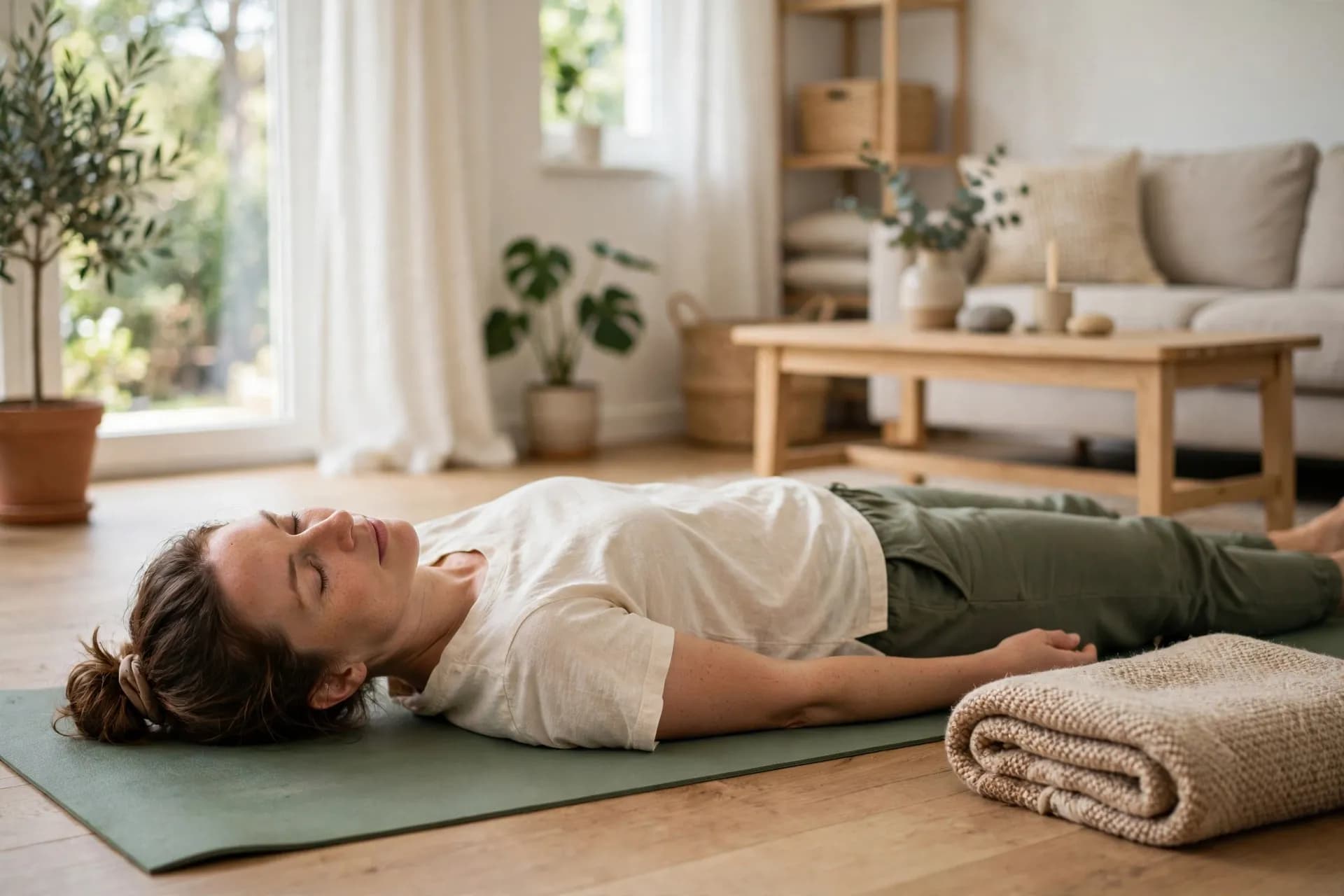
Find a quiet spot where you will not be disturbed. Sit or lie down, loosen anything tight, and close your eyes if that feels comfortable.
- Take three slow breaths, in through your nose and out through your mouth.
- Start at your feet. Curl your toes, hold for about five seconds, then let go.
- Move to your legs. Tense your calves and thighs, hold for five seconds, then release.
- Tighten your stomach. Hold, then release, and let your belly soften as you breathe out.
- Squeeze your hands. Make fists, then let your fingers open wide.
- Lift your shoulders toward your ears, hold for five seconds, then drop them.
- Scrunch your face. Squeeze your eyes shut, press your lips together, and wrinkle your forehead. Then release and let your whole face soften.
- Rest for a minute. Scan once more from head to toe, then open your eyes slowly.
Your Day 2 Plan: Do This Today
- Pick a quiet time today, ideally in the evening.
- Do the full 5 to 10 minute scan once, feet to face.
- Note which part felt the tensest.
- Try the 60 second version once more later, on shoulders, jaw, and hands.
Common Mistakes
Tensing too hard. A firm squeeze is enough. Stop if anything cramps or hurts.
Rushing through the steps. The release is the lesson, not the squeeze. Give yourself a few seconds to notice how the muscle feels.
Expecting instant calm. You do not need to feel perfectly calm at the end. If your shoulders dropped a little, the practice worked.
What if you fall asleep?
That is fine, and it happens often, especially in the evening. A body scan is a good way to wind down, and many people find a relaxed body makes it easier to drift off. If you want to stay awake, try it sitting up instead of lying down, or do it earlier in the day.
What To Do Next
You now have two tools: slow breathing from Day 1 and a body scan from Day 2. Tomorrow, in Day 3: Walking for Stress Relief (5-Minute Reset), you will add movement. This article is Day 2 of 7 in Stress Reset.
When to see a doctor
Talk with your doctor if stress feels overwhelming, does not ease after a few weeks, or keeps stopping you from working or sleeping. More calm tools are in our mental well-being hub.
This article is for general information only and is not medical advice, diagnosis, or treatment. A body scan and progressive muscle relaxation are self-help tools for everyday stress, not a treatment for any mental health condition. If stress feels overwhelming, or it keeps getting in the way of your daily life, talk to your doctor or a qualified healthcare professional.
The takeaway
Progressive relaxation is like a body scan that has a mental component and a physiological component. It involves using breathing and visualization to help you acknowledge and release the tension you hold in every area of your body.
Frequently asked questions
How long does a body scan take?
The full version takes 5 to 10 minutes. A short version, covering just shoulders, jaw, and hands, takes about 60 seconds.
Is a body scan the same as meditation?
It is a practical form of meditation. You do not need to clear your mind. You only need to notice what you feel, one part at a time.
Can a body scan help me sleep?
Yes, for many people. A relaxed body makes it easier to drift off, so it works well in the evening. More ideas are in our sleep hub.
Can I do a body scan lying in bed?
Yes. Lying in bed works well, especially in the evening. Just know that you may fall asleep, which is fine if sleep is what you need.
How we reviewed this article
Beargoal has strict sourcing guidelines and relies on peer-reviewed studies, academic research institutions and medical associations. We avoid tertiary references. Learn more in our editorial process.
- Mayo Clinic Relaxation techniques: Try these steps to lower stress. https://www.mayoclinic.org/healthy-lifestyle/stress-management/in-depth/relaxation-technique/art-20045368
No revisions recorded yet.
Medically reviewed by Sam WhitfieldFact checked by Lena Hartmann, PhDWritten by Daniel Reyes, MS, RD
This content is for informational purposes only and is not medical advice, diagnosis or treatment. Read our full disclaimer.